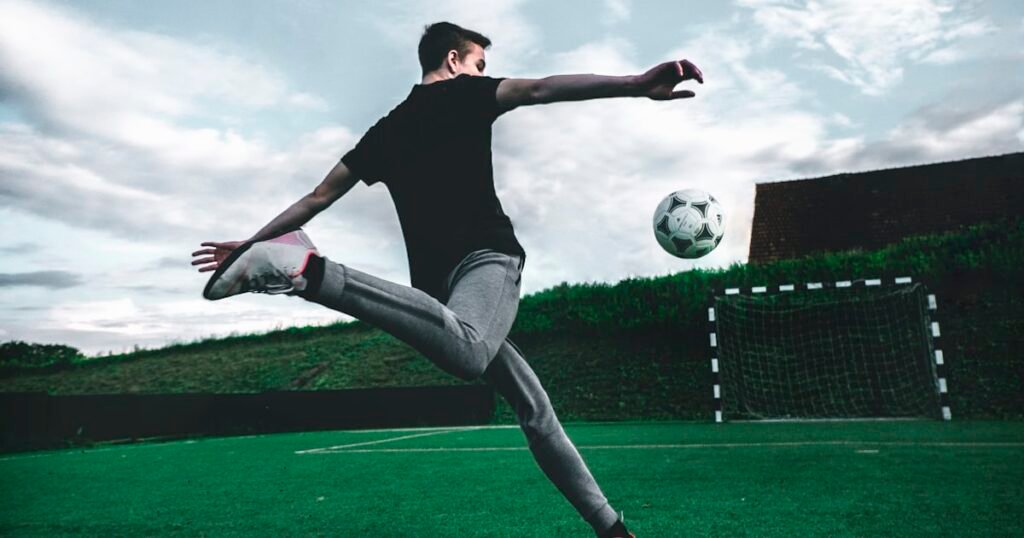
A free kick in football is a method of restarting play after the referee has stopped the game due to a foul or infringement of the Laws of the Game. There are two types of free kicks — direct and indirect — each with different rules about how a goal can be scored from them. Free kicks are among the most important set-piece situations in football, with approximately 30 to 35 percent of all goals in professional football coming from set-piece situations, including free kicks, corners, and penalties. Mastering the art of taking and defending free kicks is a crucial skill, and understanding the nuances of these situations can significantly improve your ability to predict match outcomes.
Direct vs Indirect Free Kicks: Understanding the Difference
A direct free kick allows the kicker to score a goal directly by kicking the ball into the opponent’s goal without it needing to touch another player first. Direct free kicks are awarded for physical fouls against an opponent, including kicking, tripping, pushing, holding, charging, striking, or jumping at an opponent in a manner deemed careless, reckless, or using excessive force. Deliberate handball is also punished with a direct free kick. The vast majority of free kicks awarded in a typical match are direct free kicks, and when they are awarded in dangerous positions near the penalty area, they represent significant goalscoring opportunities.
An indirect free kick requires the ball to touch at least one other player before a goal can be scored. If the kicker sends the ball directly into the goal without it touching anyone else, a goal kick is awarded to the defending team. The referee signals an indirect free kick by raising one arm above their head and maintaining this signal until the ball is played and touches another player or goes out of play. Indirect free kicks are awarded for less physical offences such as obstruction, dangerous play, offside, goalkeeper infringements (such as picking up a back-pass or holding the ball for more than six seconds), and impeding an opponent’s progress without contact.
The defending team must position their players at least 9.15 metres (ten yards) from the ball when a free kick is taken. In practice, the referee will pace out this distance and use vanishing spray to mark both the position of the ball and the minimum distance for the defensive wall. Vanishing spray, introduced widely around 2014, has significantly improved free kick execution by preventing defenders from encroaching before the kick is taken. Before its introduction, defensive walls routinely inched forward during the setup, reducing the kicker’s effective angle and distance.
A relatively recent rule change requires attacking players to remain at least one metre from any defensive wall consisting of three or more players. This rule was introduced to prevent the tactic of attackers standing in the wall to create confusion and obstruct the goalkeeper’s view, then jumping out of the way as the ball was struck. By requiring a clear metre of space, the rule has simplified wall management for defenders but has also forced free kick specialists to develop new techniques and routines to create scoring opportunities.
Free Kick Techniques and Specialist Kickers
The art of free kick taking has evolved significantly over the decades, with specialist kickers developing a range of techniques to beat defensive walls and goalkeepers. The most common technique for free kicks within shooting range (approximately 18 to 30 yards from goal) is the curled shot, where the kicker strikes the ball with the inside of their foot to impart sidespin, causing the ball to bend around the wall and towards the goal. Right-footed players typically curl the ball from left to right (from the goalkeeper’s perspective when the free kick is on the right side), while left-footed players curl it the opposite way.
The knuckleball technique, popularized by Cristiano Ronaldo and Juninho Pernambucano, involves striking the ball with minimal spin, causing it to move unpredictably through the air due to aerodynamic effects. This technique is particularly difficult for goalkeepers to read because the ball’s trajectory changes in flight, making it nearly impossible to anticipate where it will end up. However, the knuckleball is also less accurate than the traditional curled technique, and its effectiveness depends heavily on conditions such as wind speed and ball type.
Dipping shots, driven low under the wall, and chipped free kicks over the wall are other variations that specialist kickers employ depending on the distance, angle, and defensive setup. Some teams use elaborate rehearsed routines for free kicks in dangerous positions, involving dummy runs, short passes to change the angle, or multiple players standing over the ball to create uncertainty about who will take the kick. These routines are typically practiced extensively on the training ground and can be devastatingly effective when executed correctly.
The conversion rate for free kicks varies significantly based on distance and angle. Free kicks taken from within 20 yards of goal and in central positions have a conversion rate of approximately 5 to 8 percent for elite takers, which drops to around 2 to 3 percent for kicks from wider angles or greater distances. While these percentages may seem low, the best free kick specialists — players like Lionel Messi, David Beckham, Juninho, and Andrea Pirlo — maintained career conversion rates well above the average, making free kicks a genuine scoring threat whenever they were in range.
Defending Free Kicks: The Wall and Goalkeeper Positioning
Defensive organisation at free kicks is a critical aspect of team preparation. The standard approach involves forming a wall of players to block the most direct path to goal, with the goalkeeper positioning themselves to cover the exposed side. The number of players in the wall varies depending on the position and distance of the free kick, typically ranging from two to five players. For central free kicks close to the goal, teams may use a wall of four or five players, while for free kicks from wider positions, a smaller wall or no wall at all may be preferred.
The goalkeeper’s positioning relative to the wall is a subject of constant tactical debate. Traditional coaching positions the goalkeeper to cover the side of the goal not protected by the wall, trusting the wall to block shots aimed at their side. However, this creates a vulnerability if the kicker manages to get the ball over or around the wall on the goalkeeper’s blind side. Some modern goalkeeping coaches advocate for the goalkeeper to position themselves more centrally, accepting a small gap on the wall’s side in exchange for better coverage of the goal overall.
Many teams now also position a player lying down behind the wall to prevent the kicker from driving the ball underneath the jumping wall. This tactic became widespread after several high-profile goals were scored by striking the ball low under a wall that jumped to block a higher shot. The lying player acts as a backstop, ensuring that the low channel is blocked regardless of whether the wall jumps or stays grounded. This evolution demonstrates how free kick tactics continue to develop as attacking and defensive innovations drive each other forward.
Free Kicks in Correct Score Predictions
Free kicks contribute meaningfully to correct score predictions because they represent a semi-predictable source of goals that is distinct from open-play goalscoring. Teams with elite free kick takers effectively have an additional weapon in their arsenal, and matches involving these teams tend to produce slightly different goal distributions than those between teams without a free kick specialist. The number of free kicks a team wins in dangerous positions also varies based on their playing style, with technically skilled, attack-minded teams that carry the ball into the final third tending to win more fouls in shooting range.
From a prediction perspective, the free kick dimension adds nuance to correct score analysis. A team with a world-class free kick taker facing a team that concedes frequent fouls in dangerous positions has a specific route to goal that may not be fully captured by standard expected goals models. Similarly, teams with poor free kick defending records — whether due to wall organisation, goalkeeper positioning, or both — may be more vulnerable to conceding from set pieces, which affects the probability of various scorelines.
Referee tendencies also play a role in free kick-related predictions. Some referees award significantly more free kicks per match than others, and the location of these free kicks varies based on the official’s interpretation of what constitutes a foul in different areas of the pitch. A referee who is quick to penalise challenges in the final third creates more dangerous free kick opportunities, which in turn increases the probability of goals from these situations.
At Correct Score Predict, our models consider set-piece data including free kick conversion rates, defensive vulnerabilities from set pieces, and the presence of specialist dead-ball kickers when generating scoreline forecasts. Understanding the full picture of how goals are scored — from open play, penalties, corners, and free kicks — helps produce the most accurate predictions possible.