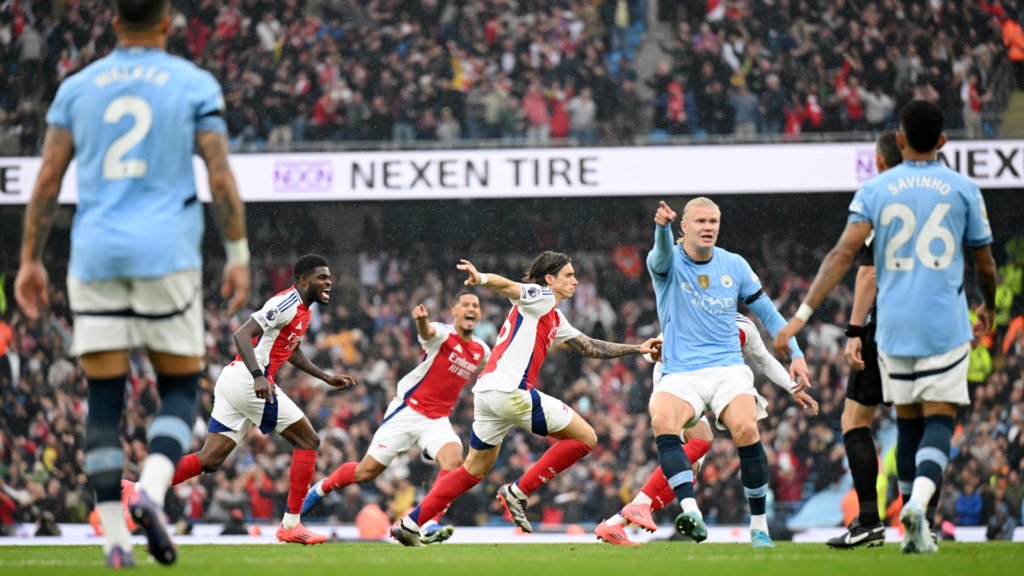
The away goals rule was a method used to determine the winner of a two-legged knockout tie in football when the aggregate score was level after both matches. Under this rule, the team that scored more goals away from home across the two legs was declared the winner, eliminating the need for extra time or penalties. For decades, the away goals rule was one of football’s most distinctive and influential regulations, shaping tactical approaches to two-legged ties and producing some of the sport’s most dramatic moments. In 2021, UEFA abolished the rule from all of its club competitions, marking the end of an era that had lasted since 1965.
How the Away Goals Rule Worked
The mechanics of the away goals rule were straightforward in principle but created complex tactical dynamics in practice. In a two-legged tie, each team plays one match at home and one away. At the end of both matches, the aggregate score is calculated by adding together the goals from both legs. If the aggregate score was tied, the away goals rule was applied: whichever team scored more goals in the match they played away from home was declared the winner. Only if the away goals were also equal would the match proceed to extra time and, if necessary, a penalty shootout.
To illustrate with an example: if Team A won the first leg at home 2-1, and Team B won the second leg at home 2-1, the aggregate score would be 3-3. Under the away goals rule, Team B would advance because they scored two away goals (in the first leg) compared to Team A’s one away goal (in the second leg). This outcome felt counterintuitive to many fans because both teams won their home matches by the same scoreline, yet one team was eliminated without the opportunity for extra time.
The rule was introduced by UEFA in 1965 for the Cup Winners’ Cup and was subsequently adopted across the European Cup (later Champions League), UEFA Cup (later Europa League), and most domestic cup competitions that used a two-legged format. The original rationale was entirely pragmatic: before the rule existed, tied aggregate scores required a third match on neutral ground, which was logistically expensive and complicated to arrange, especially in an era when international travel was more difficult and costly than it is today.
Over time, the justification for the rule evolved beyond logistics. Proponents argued that it rewarded teams for attacking play away from home, where scoring goals was statistically more difficult due to the home advantage. Scoring away from home required bravery and ambition rather than a purely defensive approach, and the rule was seen as incentivizing the kind of positive, attacking football that made European competition exciting and unpredictable.
Why UEFA Abolished the Away Goals Rule
In June 2021, UEFA president Aleksander Ceferin announced the abolition of the away goals rule from all UEFA club competitions, effective from the 2021-22 season. The decision followed extensive consultation with stakeholders including clubs, coaches, and fans, and was based on several arguments that had gained traction over the preceding years.
The primary argument for abolition was that the home advantage in football had been steadily declining over decades. Research showed that home teams’ win rates, goal-scoring rates, and overall performance advantages had diminished significantly compared to the 1960s and 1970s when the rule was introduced. Factors including improved travel conditions, standardized pitch sizes and surfaces, and the globalisation of football meant that playing away from home was no longer the significant disadvantage it once was. If the underlying premise of the rule — that away goals were harder to score and therefore deserved extra value — was no longer valid, then the rule itself was no longer justified.
A second argument concerned the tactical distortions the rule created, particularly for home teams in the second leg. If the aggregate score was level during the second leg, the home team was effectively losing under the away goals rule, because any goal scored by the visiting team would count double. This meant that home teams in the second leg often played more cautiously than expected, fearing that conceding an away goal would be doubly damaging. The rule, originally intended to encourage attacking play, had paradoxically begun to produce more defensive football as teams became increasingly sophisticated in their understanding of its tactical implications.
The COVID-19 pandemic provided an unexpected test case for the rule’s relevance. During the 2019-20 Champions League knockout rounds, several matches were played at neutral venues without fans due to pandemic restrictions. This eliminated the home advantage entirely, making the away goals rule arbitrary — there was no meaningful distinction between home and away goals when neither team had any actual home advantage. While this was an extraordinary circumstance, it highlighted the fragility of the rule’s underlying logic.
Famous Away Goals Moments in Football History
The away goals rule produced some of the most dramatic and emotionally charged moments in European football history. Perhaps the most famous was Barcelona’s incredible 6-1 victory over Paris Saint-Germain in the 2017 Champions League Round of 16 second leg, after losing the first leg 4-0. Sergi Roberto’s 95th-minute goal completed the comeback, and Barcelona advanced on away goals with an aggregate of 6-5, having scored three away goals in the first leg compared to PSG’s one. The match, known as “La Remontada” (The Comeback), encapsulated everything that made the away goals rule dramatic — the shifting balance of advantage, the awareness that each away goal carried extra significance, and the late-game heroics required to overturn the deficit.
Another iconic moment came in the 1999 Champions League semi-final between Manchester United and Juventus. United lost the first leg in Turin 1-0 but trailed 2-0 early in the second leg at Old Trafford, meaning they needed four goals without reply or three goals plus the away goals calculation. Captain Roy Keane’s headed goal began the comeback, and United eventually won 3-2, advancing 4-3 on aggregate without the away goals rule being needed — but the drama was amplified by the constant calculations about what each goal meant for the tie.
The rule also produced painful eliminations that haunted teams and their supporters. Tottenham Hotspur were eliminated from the 2019 Champions League quarter-final against Manchester City on away goals after the aggregate finished 4-4, with VAR disallowing a late Raheem Sterling goal that would have sent City through. The interplay between VAR decisions and away goals calculations created a uniquely complex and emotional conclusion that left fans of both teams emotionally exhausted.
Away Goals and Correct Score Predictions
Although the away goals rule has been abolished from UEFA competitions, understanding its legacy remains relevant for correct score prediction and analysis. The rule’s abolition has measurably changed how teams approach two-legged ties. Since 2021, second-leg matches that reach level aggregate scores now proceed to extra time rather than being decided by away goals, which has led to more cautious first-leg approaches from some teams and more open second legs as teams know they will have extra time and penalties as safety nets.
Statistical analysis of UEFA competitions since the rule change shows subtle shifts in scoring patterns. First legs have become slightly lower-scoring on average, as teams recognize that a narrow deficit can be overturned in the second leg without the complication of away goals favouring the opposition. Second legs, conversely, have become marginally higher-scoring as home teams play with greater freedom, knowing that conceding a goal does not carry the double penalty it once did under the away goals rule.
For bettors analysing two-legged ties, the absence of the away goals rule simplifies the calculation of which team is likely to advance but changes the dynamics of individual match predictions. The probability of second-leg matches going to extra time has increased since the rule change, which affects markets related to total goals, match result, and specific scoreline predictions. Understanding these post-abolition trends helps create more accurate predictions for knockout competition matches.
Some domestic competitions still use variants of the away goals rule or have their own tiebreaking mechanisms, so it is important to check the specific competition rules when making predictions for cup ties. At Correct Score Predict, we account for the specific tiebreaking rules of each competition when generating predictions for two-legged ties, ensuring our forecasts reflect the actual conditions under which each match is played.