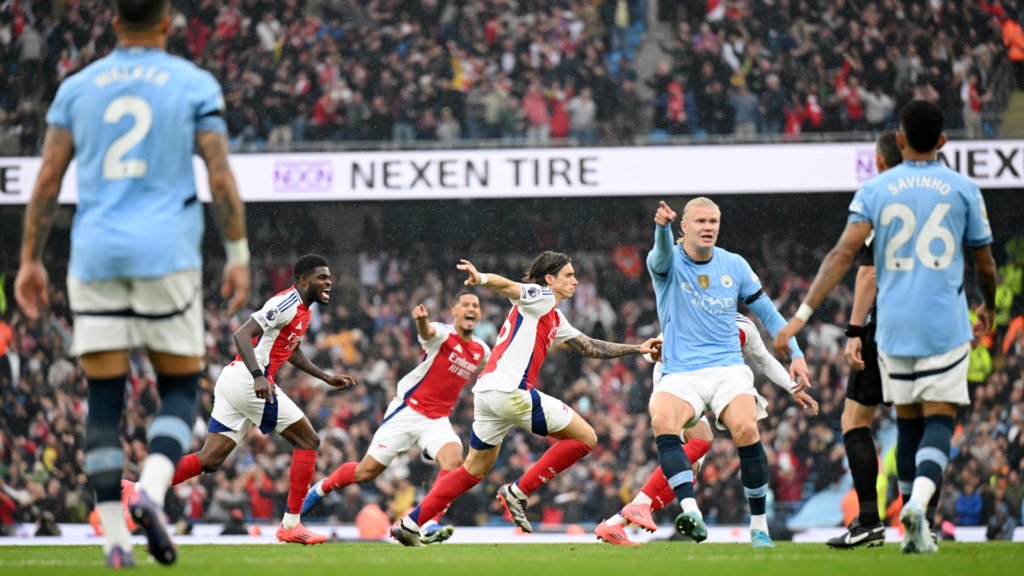
It is the 89th minute of a tense derby match. Your team’s striker makes a perfectly timed run behind the last defender, receives a through ball, and fires past the goalkeeper. The net ripples, the stadium erupts, and for a brief moment everything feels right. Then the assistant referee raises the flag. Offside. The goal is wiped out, the celebrations die, and thousands of fans are left furious and confused. If you have ever watched football and struggled to understand why a goal was disallowed, you are far from alone. The offside rule is the most debated, most misunderstood, and most consequential rule in the entire sport.
What the Offside Rule Actually Says
At its core, the rule is about positioning at one specific moment in time. A player is in an offside position when they are closer to the opponent’s goal line than both the ball and the second-to-last defender at the exact instant a teammate plays the ball to them. The second-to-last defender is almost always the last outfield player, because the goalkeeper is usually the very last player back. So in practical terms, you are offside if you are ahead of the last outfield defender when your teammate passes the ball.
But there is a critical detail that separates people who truly understand the rule from those who do not. Simply being in an offside position is not an offense by itself. The player must also become actively involved in play by doing one of three things: touching the ball that was played, interfering with an opponent (blocking their line of sight or movement), or gaining an advantage from being in that position (such as when the ball rebounds off the post or the goalkeeper). A player can stand in an offside position all day long, but as long as they do not interfere with play, the referee will not blow the whistle.
The moment that matters is when the ball leaves the passer’s foot, not when the ball arrives at the receiving player. This timing distinction is what confuses most viewers. An attacker might look clearly offside when they receive the ball, but if they were level with the defender at the moment the pass was made and then sprinted forward, they are perfectly onside. Conversely, a player might receive the ball while surrounded by defenders, but if they were ahead of the last defender when the pass was played, they are offside regardless of where they end up.
The assistant referee running along the touchline is primarily responsible for judging offside. Their job is to stay in line with the second-to-last defender at all times, watching for the split second when the ball is played forward. It is an incredibly difficult job that requires intense concentration for 90 minutes straight. In modern football, VAR technology assists with these calls, using multiple camera angles and calibrated lines drawn on the screen to make millimeter-precise judgments. Semi-automated offside technology, introduced at the 2022 World Cup, uses tracking cameras and AI to generate offside decisions in seconds, removing much of the human error from the process.
Situations Where Offside Does Not Apply
There are important exceptions to the offside rule that every fan should understand. A player cannot be offside from a goal kick, a throw-in, or a corner kick. These are restarts where the offside rule is deliberately suspended. This is why you see attacking players standing right next to the goalkeeper from corner kicks without being flagged. A player also cannot be offside if they are standing in their own half of the pitch when the ball is played. This protects teams from being caught out by the offside trap when they are in their own territory.
Another nuance involves receiving the ball directly from an opponent. If a defender deliberately plays the ball (not a deflection or a save) and it goes to an attacker who is in an offside position, offside is not called because the ball came from the opposition rather than a teammate. However, the distinction between a deliberate play and a deflection has caused enormous controversy over the years, with some decisions appearing completely arbitrary. Referees and VAR panels have struggled to consistently apply this aspect of the rule.
Why This Rule Exists and Why It Matters
Without the offside rule, football would be an entirely different and far less interesting sport. Imagine a game where attackers could simply camp next to the opposition goalkeeper and wait for long balls to be launched toward them. There would be no build-up play, no intricate passing sequences, no need for midfield creativity, and no tactical sophistication. Matches would degenerate into a back-and-forth launching contest, like a glorified version of playground kickball. The offside rule is what forces attackers to time their runs, stay involved in the team’s play, and use intelligence rather than simply standing in advantageous positions. It is the rule that makes football a tactical and team-oriented game rather than a purely individual one.
Defenders have turned the offside rule into a weapon through the offside trap, a coordinated tactic where the entire back line steps forward in unison just before a pass is played, leaving the attacker stranded in an offside position. Teams like Arsenal under Arsene Wenger became famous for executing this tactic to perfection with a back four that moved like a single organism. The trap requires extraordinary discipline and communication. If one defender is even half a step too slow in pushing up, the attacker is through on goal with nobody to beat. On the attacking side, the best strikers in history have built their careers on their ability to play right on the edge of offside. Thierry Henry, Filippo Inzaghi, and more recently Kylian Mbappe are masters of timing their runs to stay onside by millimeters, exploiting the space behind the defensive line at the exact right moment. The constant battle between attackers trying to beat the offside line and defenders trying to catch them out is one of the most fascinating tactical chess matches in football, happening dozens of times in every single match.
Offside and Modern Technology
The introduction of VAR and semi-automated offside technology has transformed how offside is applied. Before video review, the assistant referee’s call was final, and marginal decisions often went the wrong way. Now, every goal in major competitions is checked by the video team, and offside calls that would previously have been missed or misjudged are corrected. This has led to greater accuracy but also new frustrations. Fans have complained about goals being ruled out because an attacker’s toenail or shoulder was fractionally ahead of the last defender. The emotional celebration of a goal followed by the long, anxious wait for VAR confirmation has become one of the defining experiences of modern football.
There have been serious debates about introducing a tolerance margin, essentially allowing a few centimeters of leeway so that marginal calls go in favor of the attacker. Some competitions have experimented with this concept, and FIFA has explored the idea of “daylight” offside, where the attacker must be clearly ahead of the defender rather than just technically ahead. Whether these changes are adopted widely remains to be seen, but the conversation shows how central the offside rule is to the sport. Love it or hate it, the offside rule shapes every attacking move, every defensive strategy, and every moment of joy or heartbreak when a goal is scored or ruled out. Understanding it deeply makes you a better watcher, a better analyst, and a better predictor of football outcomes.