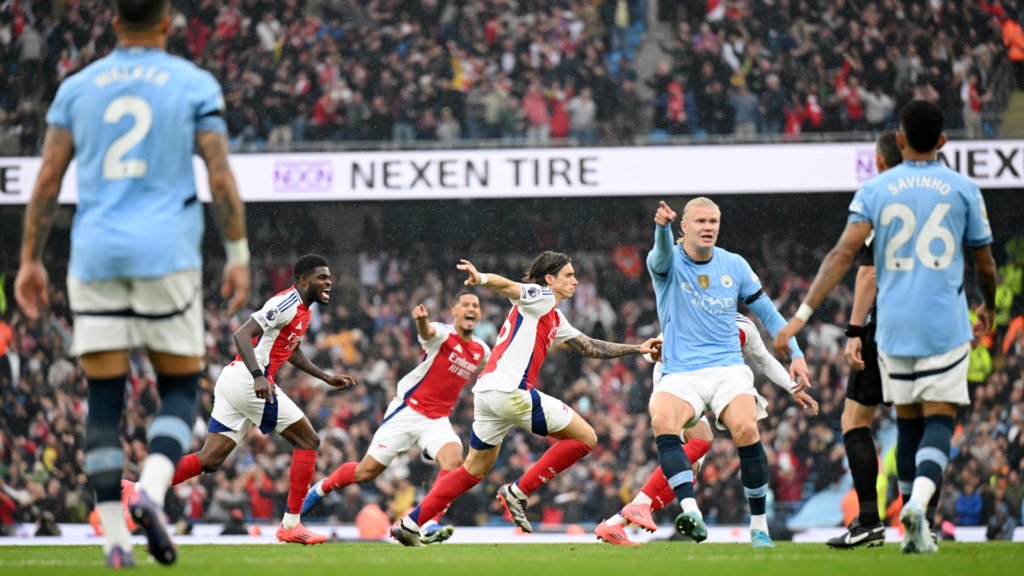
The offside trap is a defensive tactical strategy in football where a team’s defenders deliberately step forward in a coordinated movement to leave attacking players in an offside position just as the ball is played towards them. When executed successfully, the offside trap catches opponents offside and wins possession for the defending team through a free kick. When it fails, it can leave attackers with clear goalscoring opportunities against an exposed defence. The offside trap is one of football’s most sophisticated and high-risk defensive techniques, requiring precise coordination, communication, and timing among the entire defensive line.
How the Offside Trap Works
The basic principle of the offside trap is straightforward: as an opposing player prepares to pass the ball forward to a teammate making a run towards goal, the defending team’s backline steps up quickly and simultaneously. If the timing is correct, the attacking player who was running towards goal is caught behind the defensive line at the moment the ball is played, placing them in an offside position. The assistant referee raises their flag, and the defending team is awarded an indirect free kick from the position where the offside offence occurred.
Successful execution of the offside trap requires several elements to work in concert. First, the entire defensive line must move as a single unit — if one defender steps up while another holds their position, a gap is created that keeps the attacker onside. Second, the timing must be precise — the defensive line must step up at exactly the moment the pass is played, not before (which gives the attacker time to adjust their run) and not after (which means the attacker is already onside when the ball is released). Third, the defenders must communicate constantly, with one player typically acting as the defensive leader who calls the movement.
The defensive line’s starting position is crucial to the offside trap’s effectiveness. A high defensive line that plays close to the halfway line creates more space behind the defenders but also compresses the playing area in the opposition’s half, limiting the space available for attacking build-up play. This compression is one of the primary tactical benefits of a high line — it forces the opposition to play in a smaller area, which increases the probability of winning the ball back quickly if possession is lost. However, the space behind a high line is the vulnerability that opponents seek to exploit, and the offside trap is the defensive mechanism designed to protect against these runs into the space.
In the VAR era, the offside trap has become even more precise and high-stakes. Semi-automated offside technology can detect margins of centimetres, meaning that an offside trap that would have been called successful by the naked eye may be overturned if a defender’s toe was playing the attacker onside. This technological precision has forced defensive lines to be even more coordinated and disciplined in their stepping movement, as the margin for error has effectively been reduced to near zero.
Teams and Managers Famous for the Offside Trap
Several managers have built their defensive strategies around the offside trap with remarkable success. Jorge Jesus at Benfica and Flamengo was known for his aggressive high defensive line that relied heavily on the offside trap, with his teams consistently recording among the highest offside counts against opponents in their respective leagues. His approach demanded exceptional concentration and positional discipline from his defenders but also contributed to an intense pressing game that suffocated opponents in their own half.
Arsenal under Arsene Wenger famously employed a high defensive line with the offside trap as a central component during the late 1990s and early 2000s. The defensive quartet of Lee Dixon, Tony Adams, Martin Keown, and Nigel Winterburn (later replaced by Ashley Cole) operated the trap with military precision, stepping up in unison to catch opposing forwards offside. Adams, as the defensive leader, directed the line’s movements with authority, and the system contributed to some of the best defensive records in Premier League history, including the unbeaten season of 2003-04.
In contemporary football, teams managed by coaches who favour high pressing and intense forward defending — such as Jurgen Klopp’s Liverpool, Julian Nagelsmann’s teams, and various coaches from the Red Bull school of football — rely on the offside trap to protect the space behind their high defensive lines. These teams accept the occasional goal conceded when the trap fails as an acceptable trade-off for the territorial and possession advantages that a high line with an active offside trap provides.
The offside trap has also produced some of football’s most frustrating and controversial moments. Numerous goals have been disallowed for fractional offside decisions where the trap appeared to have failed but was saved by a defender’s positioning that kept the attacking player marginally offside. Similarly, many goals have been scored when the trap failed by inches, with defenders left appealing for offside while the ball hits the back of their net. These fine-margin moments highlight both the effectiveness and the risk inherent in the strategy.
When the Offside Trap Fails
The offside trap’s biggest weakness is that when it goes wrong, the consequences are severe. A mistimed stepping movement, a defender who reacts a fraction of a second late, or a perfectly timed attacking run can leave the opposition striker through on goal with no defenders between them and the goalkeeper. These one-on-one situations have a conversion rate of approximately 30 to 40 percent, making them among the highest-quality chances in football. A single failure of the offside trap can therefore lead directly to a goal, which is why teams that employ the strategy must accept a certain level of defensive vulnerability.
Opponents can exploit the offside trap through several methods. The most effective is the well-timed run from a deep position, where an attacker starts from behind the ball and accelerates past the defensive line at the exact moment the pass is played. Because the attacker is coming from an onside position and has momentum, the defenders’ stepping movement may not be sufficient to catch them offside. Quick combination play in and around the defensive line can also defeat the trap, as rapid short passes can be played before the defensive line has time to reorganize and step up.
Pace is the most dangerous weapon against an offside trap. Strikers with exceptional acceleration — players like Kylian Mbappe, Vinicius Junior, and Mohamed Salah — can time their runs to stay onside by fractions while having the speed to get behind the defensive line and reach the ball before the goalkeeper. Against such opponents, teams often adjust their offside trap strategy, either lowering the defensive line to reduce the space behind them or abandoning the trap altogether in favour of a deeper, more conservative defensive approach.
Offside Traps and Correct Score Predictions
The offside trap has meaningful implications for correct score predictions because it affects both the frequency and quality of goalscoring opportunities in a match. Teams that play with a high defensive line and active offside trap tend to produce matches with specific characteristics: fewer but higher-quality chances for the opposition (as failed traps create clear one-on-one situations), more free kicks in deeper defensive positions (from successful offside calls), and a general pattern of either clean sheets or goals conceded from breakaways rather than sustained pressure.
When a team that plays a high line with an offside trap faces a team with fast forwards who excel at running behind defences, the match setup favours a higher probability of goals at both ends. The high-line team will create chances through their pressing and territorial dominance, while the fast-forward team will create chances through runs behind the line when the trap fails. Scorelines like 2-1, 3-2, and 2-2 become more likely in these matchups compared to encounters between two defensive teams.
Conversely, when a high-line team faces an opponent that plays slowly and does not threaten the space behind the defence, the offside trap is rarely tested, and the high line simply compresses play into the opposition’s half. In these matches, the high-line team tends to dominate territorially, and the most likely outcomes are low-scoring victories like 1-0 or 2-0, with the occasional 0-0 if the defending team’s low block holds firm.
At Correct Score Predict, our models consider defensive strategies including high-line play and offside trap frequency when evaluating match dynamics. Understanding how a team defends — not just how many goals they concede — helps produce more nuanced scoreline predictions that reflect the tactical realities of each specific fixture.