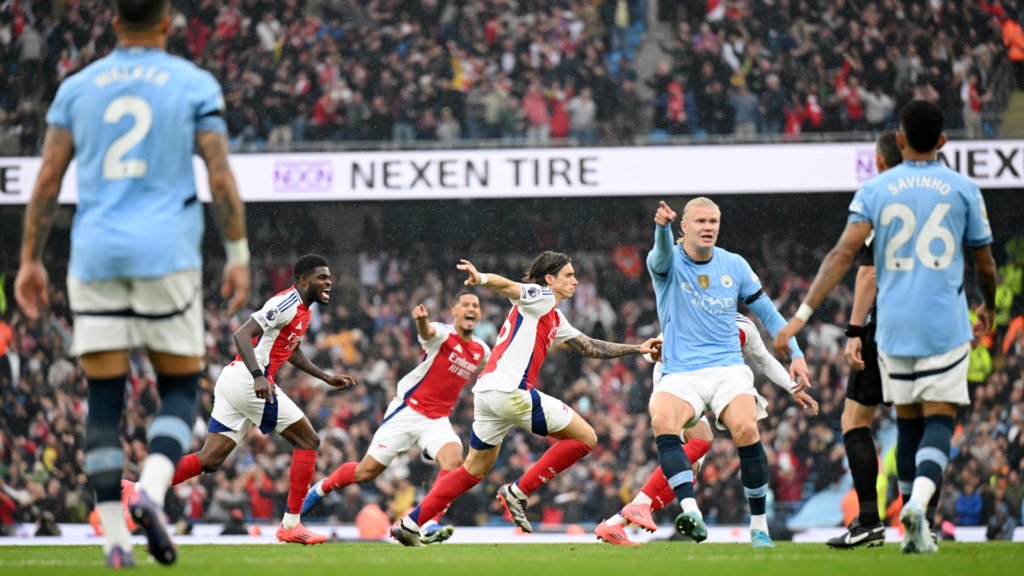
In football, a red card is the most severe disciplinary action a referee can take against a player during a match. When a player receives a red card, they are immediately sent off the field and cannot be replaced by a substitute, leaving their team to play with one fewer player for the remainder of the match. Understanding what triggers a red card, how it affects the game, and its broader implications is essential knowledge for any football fan, bettor, or aspiring analyst.
What Offences Lead to a Red Card?
The Laws of the Game, maintained by the International Football Association Board (IFAB), outline specific offences that warrant a red card. These offences are categorized into several groups, each reflecting a serious breach of fair play or player safety. The most common reason for a straight red card is serious foul play, which refers to a tackle or challenge that uses excessive force or endangers the safety of an opponent. A two-footed lunge, a studs-up challenge aimed at the ankle or knee, or any action that could cause serious injury typically falls into this category.
Violent conduct is another major reason for a red card. Unlike serious foul play, violent conduct does not need to occur during a challenge for the ball. It includes actions such as headbutting an opponent, elbowing someone away from the ball, spitting at any person, or biting. These actions are considered reprehensible regardless of the context, and referees have no discretion — they must issue a red card. In 2006, Zinedine Zidane received the most famous red card in history for headbutting Marco Materazzi in the World Cup final, illustrating how violent conduct can overshadow even the biggest matches.
Denying an obvious goal-scoring opportunity (commonly known as DOGSO) is another offence punishable by a red card. If a player deliberately handles the ball to prevent a goal, or commits a foul that stops an opponent who would otherwise have a clear chance to score, the referee can show a red card. However, there is an important exception: if the foul occurs inside the penalty area and the referee awards a penalty kick, the offending player typically receives a yellow card instead of a red card, unless the foul involved no attempt to play the ball. This rule change, introduced in 2016, was designed to avoid the perceived double punishment of a red card plus a penalty.
Using offensive, insulting, or abusive language or gestures towards the referee, opponents, or teammates can also result in a red card. Additionally, a player who receives two yellow cards in the same match is shown a red card and sent off, commonly referred to as a second yellow. This accumulation rule means that players who have already been cautioned must be extremely careful with their subsequent challenges and behavior.
How Does a Red Card Affect the Match?
The immediate impact of a red card is significant and often game-changing. The team that has a player sent off must continue with ten players (or fewer, if additional red cards follow), and they cannot bring on a substitute to replace the dismissed player. This numerical disadvantage affects every aspect of the team’s performance, from their ability to press high and create chances to their defensive solidity and stamina management.
Statistical analysis consistently shows that receiving a red card dramatically changes a team’s chances of winning. On average, a team reduced to ten players wins only about 25 percent of the time, compared to roughly 45-50 percent when at full strength. The impact is even more pronounced if the red card occurs in the first half, as the disadvantaged team must cope with being a player short for a longer period. Managers typically respond to a red card by withdrawing an attacking player and reorganizing their formation to be more defensive, often switching to a compact 4-4-1 or 5-3-1 shape.
For bettors, a red card is one of the most significant in-play events. Live betting odds shift dramatically after a sending off, with the team that has the numerical advantage seeing their odds shorten considerably. The over/under goals market also adjusts, as games with a red card in the first half tend to produce slightly fewer goals on average due to the disadvantaged team’s defensive approach, although this is not always the case if the team continues to push forward recklessly.
The psychological impact of a red card should not be underestimated either. The team with ten players may rally together and show increased determination, sometimes performing better than expected due to a siege mentality. Conversely, the team with the numerical advantage may become complacent or struggle to break down a well-organized defensive unit. Some of football’s most memorable results have come when a ten-man team defied the odds, such as Chelsea winning the 2012 Champions League semi-final second leg against Barcelona despite having John Terry sent off early in the match.
Suspensions and Longer-Term Consequences
A red card carries consequences beyond the immediate match. In most domestic leagues, a player who receives a straight red card for violent conduct faces a minimum three-match suspension. A red card for serious foul play typically carries a one to three-match ban depending on the severity and the competition’s disciplinary code. A second yellow card leading to a red card usually results in a one-match suspension only.
In UEFA competitions such as the Champions League and Europa League, a straight red card results in an automatic one-match ban, with additional games added depending on the severity of the offence. In FIFA World Cup qualifying and tournament matches, the disciplinary procedures follow similar principles but with their own specific regulations. Players and clubs have the right to appeal a red card decision, and if a successful appeal is made, the suspension may be reduced or overturned entirely.
Repeated red cards can also trigger longer bans. If a player accumulates multiple red cards over a season, they may face escalating suspensions. In extreme cases, players can receive bans of ten or more matches for particularly egregious conduct. Eric Cantona’s infamous kung-fu kick on a Crystal Palace fan in 1995 resulted in an eight-month ban from all football, demonstrating that the consequences of violent conduct can extend far beyond a standard suspension.
Red Cards in Correct Score Predictions
When making correct score predictions, the possibility of a red card adds an important layer of uncertainty. While you cannot predict when a red card will occur, understanding which matches are more likely to produce one can inform your betting strategy. Derby matches, high-stakes knockout games, and fixtures with a history of heated encounters tend to produce more red cards than average.
If you are betting in-play and a red card occurs, the correct score market shifts significantly. The most likely scorelines change based on which team has the advantage, what the current score is, and how much time remains. A team leading 1-0 with a man advantage is far more likely to extend their lead, making scorelines like 2-0 or 3-0 more probable. Conversely, a team that is both losing and down to ten players is unlikely to mount a comeback, making the current scoreline or further goals for the opposition the most probable outcomes.
Historically, matches featuring a red card produce an average of 2.4 goals, which is slightly below the overall average. This is because the ten-man team typically prioritizes defensive organization, reducing the overall tempo and number of chances created in the match. However, this average masks significant variation — some red card matches end goalless while others produce four or five goals if the depleted team is forced to chase the game.
At Correct Score Predict, our prediction models account for historical red card data and disciplinary trends when generating match forecasts. Understanding the full implications of a red card helps you make more informed decisions whether you are predicting scorelines before kickoff or adjusting your strategy during a live match.